

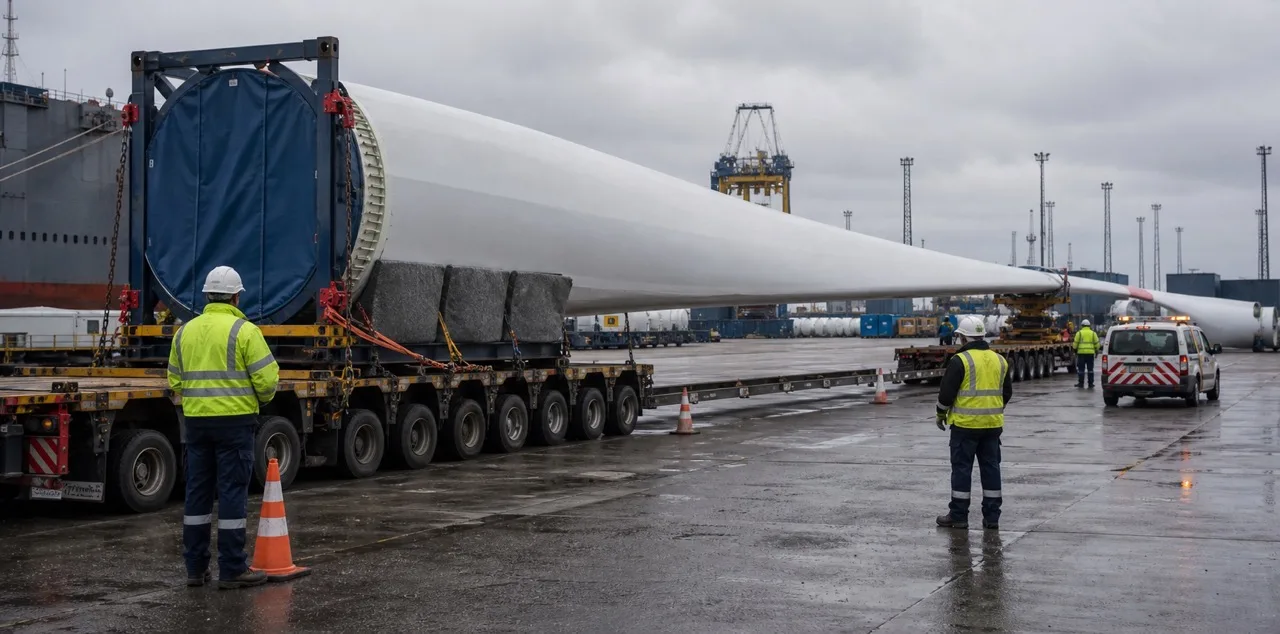
Motril’s wind blade transport upgrades could give project cargo shippers another Mediterranean routing option, but the value depends on whether the port’s berth, storage, lifting and landside access match each shipment’s dimensions and delivery plan. Treat the upgrades as a reason to reassess routes—not as proof that every blade can be handled without special arrangements.
What the upgrades could change for wind blade shipments
Wind blades are unusually long, sensitive cargo. Their length, shape and lifting requirements can limit which vessels, berths and inland corridors are practical. Improvements at a port can help by increasing usable handling space, simplifying cargo transfer or supporting safer movement between the quay and temporary storage. The exact benefit depends on the completed works and the blade’s cargo plan.
For buyers, Motril may be worth evaluating when the project is in southern Spain or when a Mediterranean discharge point improves the overall inland route. It can also provide an alternative to ports that are congested, unavailable for a required vessel call or poorly placed for the final delivery. A shorter sea route does not automatically mean a faster or cheaper project: the vessel schedule, transshipment, port handling and final road move all matter.
Before selecting the port, request current confirmation from the port operator or local handling agent about the available berth, permitted cargo dimensions, ground-bearing capacity, storage arrangements, lifting equipment and operating windows. Upgrade announcements are not a substitute for cargo-specific acceptance.
Check the full route, not only the port call
Project cargo routing starts with the origin factory and ends at the installation site. A workable plan should connect export pickup in China, port loading, the ocean leg, discharge at Motril and delivery to the project location. Each handover introduces timing, equipment and damage risks that need to be addressed before the vessel is booked.
Compare vessel and service options
Depending on the blade dimensions and carrier acceptance, the ocean leg may use a breakbulk or heavy-lift vessel, or another suitable project-cargo service. A regular container service is not automatically appropriate for long blades. Some services may require transshipment, while specialist sailings can have limited frequency and fixed loading windows. Ask for the proposed vessel type, loading method, port rotation and any transshipment points in writing.
As an initial planning assumption, China-to-western Mediterranean port-to-port transit may take roughly 25–40 days, with longer total lead times possible when transshipment, vessel waiting, weather or project-cargo scheduling is involved. This is a planning range, not a guaranteed Motril sailing time. Allow additional time for factory readiness, export clearance, port acceptance, loading, discharge and inland permits.
Validate the inland connection
A port upgrade can improve the quay operation while leaving the hardest constraint on the road. Check the full route from Motril to the site for turning space, bridge limits, gradients, roundabouts, overhead obstructions, roadworks and suitable stopping areas. Long blades may need a specialist trailer, escort vehicles and a route survey. The survey should use actual cargo and trailer dimensions, not a generic vehicle profile.
Confirm who is responsible for obtaining any required road permits and coordinating escorts. Permit lead times and restrictions vary by route and local authority. Where a direct road move is not feasible, assess whether temporary storage, a different trailer configuration or a different discharge port would reduce overall risk.
How port handling and storage affect the plan
Blade handling is a coordinated operation. Before loading, the carrier, terminal, shipper and cargo surveyor should agree on the lifting points, slings, spreader arrangements, crane capacity and sequence. A port’s available lifting capacity must be checked against the complete lift plan, including rigging weight and operating limits—not just the blade’s stated weight.
Ask how cargo will move from vessel to quay and from quay to storage or road transport. Confirm the required laydown area, surface condition, ground-bearing limits, access for trailers and whether the terminal can accommodate the blade’s full length while preserving safe working clearances. If the terminal has time, space or operating-hour limits, include them in the schedule and cost comparison.
Damage prevention starts with proper supports and controlled movement. Use blade-specific saddles or cradles that support the manufacturer-approved locations, and protect surfaces from abrasion, impact and water ingress. Avoid unsupported assumptions about stacking or temporary storage. The handling plan should identify who inspects the cargo at each transfer and how any condition concerns are recorded.
Prepare documents and cargo data early
Incomplete dimensions can delay both vessel acceptance and port planning. Provide a cargo list with each blade’s length, width, height, gross weight, centre of gravity, lifting points and support requirements. Include clear drawings, packing details, photographs and any limits on bending, handling or exposure. Share the information before booking so the carrier and terminal can confirm feasibility.
Typical export and shipping paperwork includes a commercial invoice, packing list, shipping instructions and bill of lading details. Depending on the transaction and shipment, customs declarations, certificates of origin or other trade documents may also be required. Confirm the correct tariff classification, customs value, consignee details and import requirements with the relevant customs broker. If the cargo is part of a project shipment, keep the documentation consistent across blades, towers, nacelles and installation equipment.
For oversized inland movement, prepare the route survey, transport drawings, axle-load information and permit applications required by the authorities and carriers. Responsibilities should be clear in the contract: specify which party supplies technical data, obtains permits, arranges terminal services and pays for waiting time or rehandling.
Build a realistic cost and schedule comparison
Freight costs for wind blades are quote-specific; there is no dependable flat rate that applies to every shipment. The main rate factors include cargo dimensions and weight, vessel type, loading and discharge equipment, route and transshipment, port handling, storage duration, seasonal vessel availability and the inland distance to the project site. Special cradles, surveys, escorts, permits and out-of-hours operations may add separate charges.
Compare complete landed logistics costs rather than ocean freight alone. Request an itemised quotation that identifies origin handling, export charges, ocean freight, heavy-lift or breakbulk surcharges, destination handling, storage, customs brokerage and inland delivery. Check the quotation’s validity, currency, free-time allowance, demurrage or storage terms, and exclusions. A lower ocean rate may be outweighed by extra transfer steps or a longer road move.
Make the schedule resilient to missed sailings and port changes. Specialist cargo may not have an immediate replacement vessel if documentation, cargo readiness or terminal acceptance is late. Set deadlines for final drawings, cargo inspection, packing completion, export clearance and port delivery. Keep contingency time for weather and permit approvals, particularly when the installation date is fixed.
Protect the cargo with suitable packing and insurance
Use transport supports designed for the blade’s structure and the planned lifting method. Secure the blade against movement during ocean and road transport, while avoiding excessive lashing pressure on vulnerable surfaces. Mark lifting points and centre of gravity clearly, protect exposed edges and fittings, and confirm that preservation measures suit the expected voyage and storage conditions.
Marine cargo insurance should be reviewed against the actual route and handling plan. Confirm that the policy covers the relevant transport legs, loading and discharge, temporary storage and any inland movement. Check exclusions, deductibles, declared values and requirements for approved packing or surveys. Insurance does not replace careful handling, but it can reduce financial exposure if a covered loss occurs.
When Motril may be the right routing choice
Motril is worth comparing when its location supports the final delivery, the terminal can accept the cargo and the vessel schedule fits the project timeline. It may be less attractive if the inland corridor is difficult, a required service adds a costly transshipment or storage and handling capacity cannot be confirmed for the shipment window. Compare at least one alternative port using the same cargo data, delivery point, service assumptions and cost categories.
For China-origin project cargo, a forwarder can coordinate factory collection, export documentation, vessel planning, port handling and inland delivery as one chain. Halogis helps buyers assess breakbulk, RoRo and out-of-gauge options for heavy-equipment logistics. The key is to make the routing decision from verified cargo acceptance and a complete door-to-site plan, not from an upgrade headline alone.
Frequently asked questions
Do Motril’s upgrades guarantee that a wind blade can be handled?
No. Confirm the terminal’s current limits and obtain cargo-specific acceptance based on dimensions, weight and the handling plan.
How long can China-to-Motril shipping take?
Use roughly 25–40 days as an initial port-to-port planning range; service schedules and transshipment can extend it.
What information should shippers provide first?
Send dimensions, weight, drawings, lifting points, support requirements, origin, delivery site and target dates before requesting a firm route plan.
Send the dimensions and the lane. A planner will come back with options.